

NORTHEAST MEXICO
Wading Into the Neotropics
1–15 December 2008
Tour leader: Michael Retter
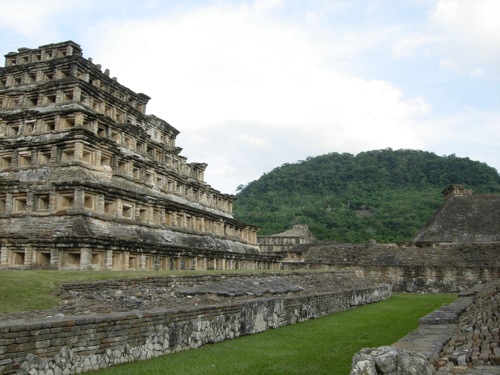
photo at left: Pyramid of the Niches, El Tajín
Northeast Mexico offers birders the opportunity to encounter many of the country’s endemic birds while traveling through habitats as diverse as high desert plateau, tropical marsh, dry upland oak forest, lowland rainforest, and montane cloudforest. While birds like Crested Guan, Azure-hooded Jay, and Collared Araçari are all undeniably tropical, we enjoyed these flavors of the Neotropics without overwhelming numbers of unfamiliar bird families, making it an excellent tour for first-timers to the tropics. We also enjoyed prolonged studies of many of the region’s endemics, like Crimson-collared Grosbeak, Worthen’s Sparrow, Sumichrast’s Wren, and Hooded and Altamira Yellowthroats. A visit to the stunning pre-Columbian ruin of El Tajín made for an especially memorable trip.
Day 1: Arrival in Monterrey
Those arriving early did some quite productive birding around the hotel today, with White-tailed Kite, Cassin’s Vireo, Cassin’s Kingbird, and Prairie Falcon being highlights. After a scrumptious meal at the adjacent restaurant, it was early to bed in order to prepare for the next morning’s early departure.
Day 2: Tanque de Emergencia and San Antonio de las Alazanas
When dawn arrived, we were just south of Saltillo, in the cold, high desert of the Mexican Plateau. I’ve often thought that the Tanque de Emergenica area is one of the best places in Mexico for bird photography, and today only reinforced that impression. Though some unexpected fog drifted in at one point, it lasted only briefly, and birds were flushing up in front of us most of the day, often pausing to perch at the top of a bush just afterward. Many times the barbed wire fences alongside the road were covered with hundreds of Western Meadowlarks, some of which delighted us with their fluted songs. A Ferruginous Hawk provided us with very close views as it perched on a fencepost. Our road then started to curve as it snaked though a couple colonies of the endangered and endearing Mexican Prairie-dog. In this more open habitat, we saw numbers of Mountain Bluebirds, Lark Sparrows, Curve-billed Thrashers, Canyon Towhees, American Pipits, Chihuahuan Ravens, and Scaled Quail. We found a Common Poorwill on the road, but it had unfortnately been struck by a car and not long before perished. We eventually got to a more heavily vegetated area, dotted with clumps of junipers and joshua trees--prime habitat for the endangered, endemic, and little-known Worthen’s Sparrow. Not long after we began our search of the area, we noticed a small group of Western Bluebirds posing in the top of a Joshua tree. As we approached for a closer look, sparrows started flushing from all around. Thankfully, a couple dozen of them were Worthen’s Sparrows! A were able to study them carefully for a great length of time as they acclimated to our presence and flew back down to feed on the ground with Black-throated Sparrows, Chipping Sparrows, and “Audubon’s” Warblers. Whenever out attention was diverted away from the Worthen’s (by, for instance, a distant Prairie Falcon), they were easy to relocate by searching for the conspicuous Western Bluebirds that were flocking with them. On the way back to the car, we found a single Lark Bunting. As we drove back to the highway, we looked back on the morning and considered ourselves remarkably lucky to have found so many Worthen’s Sparrows.
 |
 |
| Worthen's Sparrow |
Worthen's Sparrow habitat |
 |
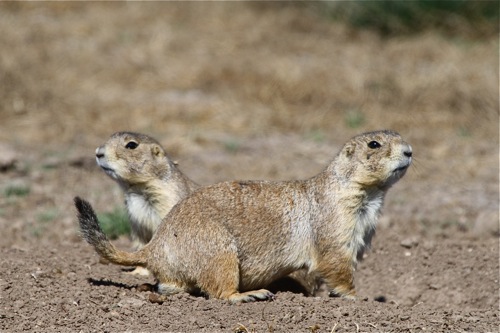 |
| Black-throated Sparrow | Mexican Prairie-dogs |
 After
lunch, we proceeded east into the highlands above San Antonio de las
Alazanas. A couple flocks of Pine Siskins (evidence of the
massive irruption further north and east) dotted the roadside along the
way.
With very little stopping, we proceeded to the end of the road. The
area had fairly recently seen a forest fire, which was very helpful in
our search for one of east Mexico’s hardest endemics. Hooded Yellowthroats specialize in
dense montane chapparal, and the fire had allowed the brush to become
quite dense. Just outside the car, we found ourselves surrounded by
small numbers of both Ruby-crowned Kinglets and Hutton’s Vireos,
allowing for close comparisons of this potentially confusing duo. Once
in good habitat, we found a male yellowthroat almost immediately.
Unbelievably, he
sat nearly motionless in full sunlight about fifteen meters away for
about five minutes! Scope views and digiscoped shots of his rictal
bristles were enjoyed by all. Quite pleased with ourselves, we headed
back up into the pine-fir forests, driving slowly until we heard a
flock, whereupon we stopped to have a
look. We found Hairy Woodpecker, Olive
Warbler, Brown Creeper, Mexican
Chickadee, Yellow-eyed Junco, Slate-throated
Whitestart, Crescent-chested
Warbler,
and (range-wise) the rarest bird of the trip:
a Grace’s Warbler. It appears
to be the first record of this species
for the state of Coahuila and all of northeast Mexico.
After
lunch, we proceeded east into the highlands above San Antonio de las
Alazanas. A couple flocks of Pine Siskins (evidence of the
massive irruption further north and east) dotted the roadside along the
way.
With very little stopping, we proceeded to the end of the road. The
area had fairly recently seen a forest fire, which was very helpful in
our search for one of east Mexico’s hardest endemics. Hooded Yellowthroats specialize in
dense montane chapparal, and the fire had allowed the brush to become
quite dense. Just outside the car, we found ourselves surrounded by
small numbers of both Ruby-crowned Kinglets and Hutton’s Vireos,
allowing for close comparisons of this potentially confusing duo. Once
in good habitat, we found a male yellowthroat almost immediately.
Unbelievably, he
sat nearly motionless in full sunlight about fifteen meters away for
about five minutes! Scope views and digiscoped shots of his rictal
bristles were enjoyed by all. Quite pleased with ourselves, we headed
back up into the pine-fir forests, driving slowly until we heard a
flock, whereupon we stopped to have a
look. We found Hairy Woodpecker, Olive
Warbler, Brown Creeper, Mexican
Chickadee, Yellow-eyed Junco, Slate-throated
Whitestart, Crescent-chested
Warbler,
and (range-wise) the rarest bird of the trip:
a Grace’s Warbler. It appears
to be the first record of this species
for the state of Coahuila and all of northeast Mexico. Day 3: The
Highrise and Cola de Caballo
Day 3: The
Highrise and Cola de CaballoThe Highrise is an incredibly tall cliff overlooking extensive pine forest, and the breeding location of our main target for the day, Maroon-fronted Parrot. We were encouraged by reports of them having been at the location just a couple weeks prior, but unfortunately we neither saw nor heard any sign of them on our visit. Despite the cold and windy conditions that greeted us at the beginning of the day, we did manage to see some great birds at this beautifully scenic location. Painted Whitestarts and Bridled Titmice seemed to always be around in the oaks, though the former were much more cooperative. A rather frustrating Pine Flycatcher flew overhead and called unseen from high in the pines. Fruiting pecan trees were full of Mexican Jays, Audubon’s Orioles, and Acorn Woodpeckers. A perched Sharp-shinned Hawk stayed just long enough for us to go over its field marks. By late morning we had descended through a spectacular gorge onto the Gulf slope of the Sierra. The wind had all but ceased, and hundreds White-throated Swifts were circling overhead. A Canyon Wren hopped through the nearby cracks in the walls of the gorge, and our first pair of sprightly Rufous-capped Warblers shared the underbrush with a Hermit Thrush. A bit further east, we came over another small ridge into the wettest forest we’d yet seen. Butterflies came out in full force, and we finally felt like we were entering the tropics. Mexican Silverspot, Chestnut Crescent, Mexican Dartwhite, Tailed Orange, and White and Yellow Angled-Sulphurs were just some of the species we noted. While looking at butterflies, we found Olivaceous Woodcreeper, Pine Flycatcher, and Rufous-capped Brush-finch. Just one motive of the brush-finch’s song played by my iPod brought the brush-finch in for incredible views on an exposed stick. The woodcreeper and flycatcher, unfortunately, were less cooperative. I was particularly disappointed in the fleeting glimpses of the woodcreeper, as this location near Cola de Caballo expands its know range northward and is probably a first record for Nuevo León. During our picnic lunch we found a Spot-breasted Wren and an American Goldfinch. From here we drove toward La Pesca, and along the way saw the first of many Brown Jays on the trip. As planned, we reached the foothills outside of La Pesca for dusk, and it was time to do some night birding. Unfortunately, the area where I found Tawny-collared Nightjars a few months prior had been bulldozed in preparation for a new divided highway, so not too surprisingly, our efforts to find that species were in vain. We did, however, find Eastern Screech-Owl and Ferruginous Pygmy-Owl.
 |
 |
| Rufous-capped Brush-finch |
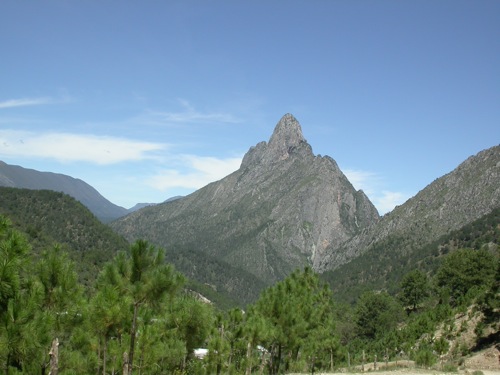
NE Mexican mountain scenery |
Day 4: La Pesca to El Cielo
We set out pre-dawn to try for the nightjars again, but turned up empty-handed. We did, however, see two Jaguarundi (one black and one brown morph) cross the road in front of us--a much rarer sight! A beautiful sunrise greeted us this morning as we tried to find Yellow-headed Parrots in the thornforest-covered foothills. These large and beautiful birds are threatened not only by habitat loss, but also by intense poaching for the cage bird trade (they’re expert mimics), so it gets harder to find them every year. Luck smiled on us today, though, and just a few minutes after sunrise a pair of Yellow-headed Parrots flew right in front of us over the highway. It’s often difficult to get an identifiable look at flying amazons, so the point-blank views of these glorious birds and their multicolored wings and glowing golden heads was quite a treat. We couldn’t believe our luck! With the parrots out of the way, we concentrated on water birds. A couple of the fish ponds just outside of town were down so low they had become mudflats, which provided a bonanza of food for the local herons, ibises, spoonbills, storks, shorebirds, caracaras, and vultures. We especially enjoyed watching a couple cinnamon-colored Long-billed Curlews, whose size was shockingly apparent when seen in direct comparison with the herons or the lingering Semipalmated Sandpiper. Much of the time, a pair of Altamira Orioles sang and showed off in the nearby thornforest. Tamaulipas Crows were ubiquitous. The adjacent Laguna Madre was full of thousands of ducks. Most of them were Lesser Scaup, which were joined by smaller numbers of American White Pelicans and Ruddy Ducks. A Sprague’s Pipit flew over, but despite much pishing refused to land. At this point, a small, dry cold front passed through, dropping the temperature and cranking up the wind very quickly. Geese began to stream by: thousands of Snow Geese. Within the closer flocks, we were able to pick out a number of smaller Ross’s Geese. Some freshwater pools just inside the coastal dunes held a small group of Northern Shoveler and Mottled Ducks, the latter at the very southern end of its range. Even with the roaring wind, we did still manage to do some birding along the coast, with American Oystercatcher and Thayer’s Gull the undisputed highlights. The wind disappeared as quickly as it started, and soon the sun again showed itself. By midday, it was time to start driving to El Cielo, but not without some birding stops along the way. Back in the foothills, we found a Ferruginous Pygmy-Owl which brought in a mob of literally dozens of birds, including Black-crested Titmouse, Orange-crowned Warbler, White-eyed Vireo, Tropical Parula, Indigo Bunting, and Blue Bunting. A small group of Wild Turkeys surprised us as they fed alongside the highway. Heavily hunted, Wild Turkeys are very rare and exceptionally hard to see in Mexico. Hawks (including White-tailed and Swainson’s) were ubiquitous on our drive towards Ciudad Victoria, and we found a large concentration of them following a plow in one particular field. A planned roadside stop near Xicoténcatl produced a very cooperative male Altamira Yellowthroat right away. At a short stop on our way up to our hotel in Gómez Farías we found Spot-breasted Wren, Melodious Blackbird, and Red-lored Parrot. Our hotel and its open air restaurant overlook part of the beautiful, pristine El Cielo Biosphere Reserve, so we were treated to an evening chorus of Crested Guan, Collared Forest-Falcon, Singing Quail, and Thicket Tinamou as we enjoyed our delicious dinner of tortilla soup and enchiladas with toasted sesame seed salsa. Later, a Mottled Owl started singing right outside our rooms.
 |
 |
| Roseate Spoonbills, Long-billed Curlew,
and egrets |
Tamaulipas Crows |
Day 5: El Cielo and the Río Frío
Breakfast this morning was abruptly interrupted when a Crested Guan started screaming from the top of the tree right next to the restaurant! We rushed outside and were rewarded with views of the bird in the spotlight before if sailed off down the canyon. What a way to start the day! As it got light outside, we could hear the bizarre machine-like gurgling sounds of a lek of male Wedge-tailed Sabrewings just outside the restaurant, and indeed, there were a couple that had set up shop in the red-flowering vine in the parking lot. Both male and female Canivet’s Emeralds came in to steal a sip of nectar while the sabrewings were dueling.
The plan was to cover the lower half of the road to Alta Cima today, because we had to be back to the lowlands in order to take our “jungle boat ride” after lunch. White-crowned Parrots were everywhere. Hundreds passed over throughout the day, and a few even landed directly above us, whereupon they proceeded to drop fruit husks on our car! An impressive Lineated Woodpecker and an endemic Bronze-winged Woodpecker fed just over the road at one point. Small flocks of Yellow-throated Euphonias were working the treetops, and one particular group joined a male Flame-colored Tanager to feed in a fruiting gumbo limbo. Crimson-collared Grosbeaks were quite common here: we heard a couple dozen, and managed views of 6 or 7, including a couple adult males, and they bounced around in the underbrush along with a large number of Gray Catbirds and a smaller number of Blue Mockingbirds. Before we knew it, it was time to head down the mountain. As we slowly descended in the car, a rustle of leaves alerted us to the presence of a small group of very cooperative Singing Quail, and everyone had very nice views of them. A Squirrel Cuckoo perched right along the road at eye level was quite welcome after the distant views we’d had earlier in the day. Just before we got back into town, we found some army ants working the roadside. They were attended by a rather curious combination of birds: a Ferruginous Pygmy-Owl, a Fan-tailed Warbler, a male Barred Antshrike, an Eastern Phoebe, a Great Kiskadee, an uncooperative Yellow-billed Cacique, and small numbers of Melodious Blackbirds and Black-headed Saltators. We watched these birds for about 45 minutes as they fed just feet in front of us, seemingly unimpressed by us as they concentrated on the fleeing smorgasboard.
 |
 |
|
| Squirrel Cuckoo |
female Canivet's Emerald |
|
 |
 |
|
| male Barred Antshrike | Fan-tailed Warbler |
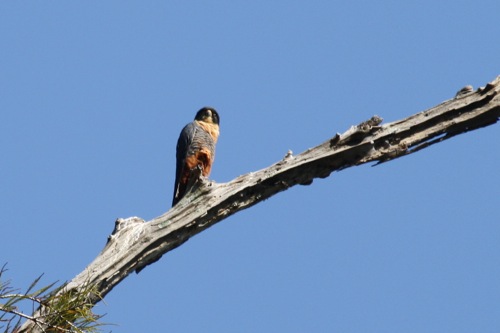
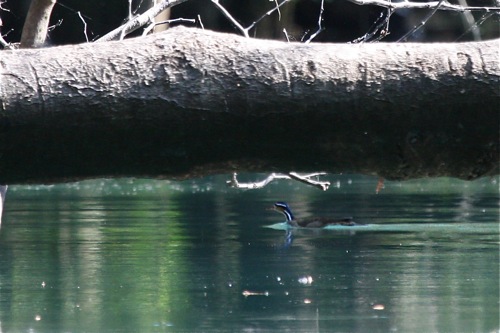
Our boat ride along the Río Frío was quite productive, yielding nice views of Sungrebe, Ringed Kingfisher, Amazon Kingfisher, Bat Falcon, Boat-billed Heron, and Louisiana Waterthrush. Birding the grounds near the dock was fruitful too. We found Clay-colored and White-throated Robins, multiple Masked Tityras, and a small flock of Yellow-winged Tanagers. Another Bat Falcon flew over the zócalo in Gómez Farías at dusk.
 |
 |
| Bat Falcon |
adult Boat-billed Heron |
 |
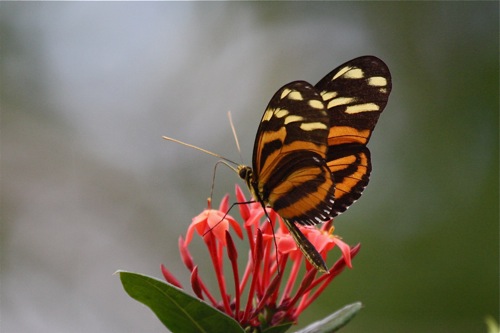 |
| female Sungrebe | Isabella Heliconian |
Day 6: El Cielo
We concentrated on the road above Gómez Farías today, slowly making out way to Alta Cima and back in time for supper. We saw most of the birds again that we’d seen here the day before, including more nice views of Crimson-collared Grosbeak. Close to Alta Cima, we found 3 countersinging male Barred Antshrikes and watched with excitement as two of them dueled for supremacy. A glowing male Blue Bunting was thoroughly appreciated. White-tipped Doves in the road ahead of us allowed detailed study of their plumage, more than enough to eliminate the scarce Gray-headed Dove. There were some new and exciting bids, as well. The most exciting bird by far was an adult Ornate Hawk-Eagle that flew by relatively low and then circled overhead for a full 2 or 3 minutes. The species is at the very northern extent of its range here, so catching sight of one is a rare occurrence. Other new birds for the trip included Smoky-brown Woodpecker, Warbling Vireo, Rose-throated Becard, Brown-backed Solitaire, White-winged Tanager, Olive Sparrow, Elegant Euphonia, Grayish Saltator, and Hooded Grosbeak. We found another army ant swam this afternoon, which was this time attended by a number of Golden-crowned Warblers, Clay-colored and White-throated Robins, and a Fan-tailed Warbler. One of us caught sign of a Crested Guan on the way down, and everyone had close views of Plain Chachalaca.
 |
 |
| adult Ornate Hawk-Eagle |
male Crimson-collared Grosbeak |
 |
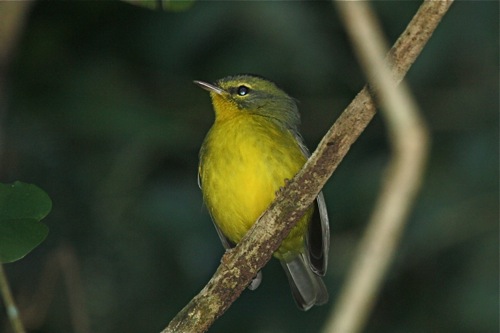 |
| male Rose-throated Becard | Golden-crowned Warbler |
Day 7: The Tula-Ocampo Road to El Naranjo
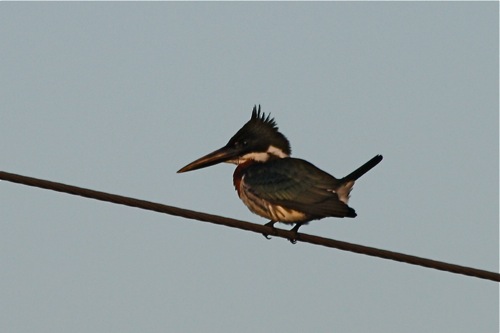
One of the first birds we saw today was an Amazon Kingfisher perched on a power line alongside the road. When we stopped for a better look, a Green Kingfisher appeared as well. It’s always nice to have similar species together for direct comparison.
As one drives south from the U.S, the upper reaches of the Tula-Ocampo road offer first real accessible habitat with “cloud forest birds”. It wasn’t too birdy this morning, though; a well-seen Brown-capped Vireo and heard-only Black-headed Nightingale-Thrush were our only “cloud forest” finds, but no matter, we’d enter true cloud forest in a couple days. After a bit of work, we managed nice views of a Long-billed Thrasher and his fiery orange eyes. Painted Whitestarts and Hepatic Tanagers were common, and a White-eared Hummingbird briefly put in an appearance. Both Bronze-winged and Smoky-brown Woodpeckers were seen here.
We crossed the Sierra and descended back onto the Mexican plateau to bird Laguna San Isidor for waterbirds. Unfortunately (if you’re looking for ducks), the reservoir was so full of sediment it had become a cattail marsh full of practically nothing but Pied-billed Grebes. The only other birds we noticed on the lake were “Mexican Duck”, Northern Pintail, Northern Shoveler, and Black-bellied Whistling-Duck. A Cassin’s Sparrow flushed out of the dry grass near the shoreline, but it refused to sit in plain sight. Disappointed, we headed back over the divide and turned south into an intermountain valley towards El Naranjo. Just a few kilometers down this road, a massive flock of parakeets flew over the car. We stopped immediately, hoping they would come back, and they did! A flock of about 70 Green Parakeets literally flew circles above us for a good 3-4 minutes before disappearing behind a ridge. A similarly large flock of Tamaulipas Crows prompted us to stop in a small town, where we also found a glorious male Hooded Oriole. Later, we were surprised to find a massive intermittent lake, full of tens if not hundreds of thousands of birds. Thankfully, it was just low enough that the road wasn’t inundated. The lake was covered with Ring-necked Ducks and American Coots, but we found a Canvasback and some Gadwall amongst them. In the shallower water, there was a flock of White-faced Ibis feeding, funnily enough, joined by a pair of Muscovy Ducks. A couple families of Northern Jaçanas glided along the lily pads below a sunning Anhinga. We could hear Ruddy Crakes and Soras calling from the distant reeds, but there was unfortunately no way to get to them. A bit further down the road, we found a posing pair of Aplomado Falcons in the top of a lone palm tree. The impressive waterfall at El Meco greeted us as we arrived in El Naranjo valley in time for supper.
 |
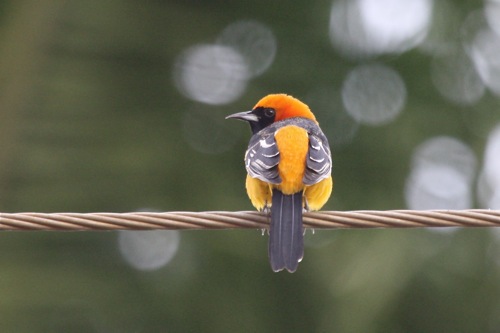 |
| Amazon Kingfisher | male Hooded Oriole |
 |
 |
| adult Northern Jaçana | El Meco waterfall |
Day 8: El Naranjo
 The
open understory of the subtropical oak woodlands above El Naranjo make
the area one of the easiest places in the world to see Singing Quail.
We were entertained by a particularly loud male this morning, who
besides giving nice view through the vegetation, even ran across an
open trail for us! With some patience, there’s usually a nice
mixed flock here led by Crescent-chested Warblers and White-winged
Tanagers, and we did have to wait an hour or so today, but there were
plenty of other birds in the cut-over farm fields with which to occupy
our time. A very photogenic pair of Rusty
Sparrows was by far and away
the winner, but they had to compete with equally cooperative pairs of Rufous-capped Warbler and Audubon’s Oriole. Our
attention was diverted
back to the forest once the mixed flock materialized, and within it we
found Tropical Parula, Painted Whitestart, White-winged Tanager, and Crescent-chested,
Townsend’s, Nashville, Wilson’s, Golden-crowned,
Black-throated Green, and Black-and-white Warblers. An Ovenbird gave
only fleeting glimpses as it stalked insects in the understory. It was
also here that we found an amazing hummingbird hawk moth with a white
band across its “rump”, appearing to mimic a coquette—or was it the
other way around? Something to ponder! A stop in the higher,
drier oaks around Agua Zarca failed to produce Spotted Wren, but we
found an amazing flock of “large” birds, including Olivaceous, Spot-crowed, and Ivory-billed Woodcreepers; Acorn, Smoky-brown, and Bronze-winged Woodpeckers, Gray-collared Becard,
Green Jay, Rufous-browned Peppershrike,
and a female Barred Antshrike.
The
antshrike was particularly interesting as she fed high in the canopy
with the Green Jays. It was certainly a behavior none of us had ever
seen in the species before.
The
open understory of the subtropical oak woodlands above El Naranjo make
the area one of the easiest places in the world to see Singing Quail.
We were entertained by a particularly loud male this morning, who
besides giving nice view through the vegetation, even ran across an
open trail for us! With some patience, there’s usually a nice
mixed flock here led by Crescent-chested Warblers and White-winged
Tanagers, and we did have to wait an hour or so today, but there were
plenty of other birds in the cut-over farm fields with which to occupy
our time. A very photogenic pair of Rusty
Sparrows was by far and away
the winner, but they had to compete with equally cooperative pairs of Rufous-capped Warbler and Audubon’s Oriole. Our
attention was diverted
back to the forest once the mixed flock materialized, and within it we
found Tropical Parula, Painted Whitestart, White-winged Tanager, and Crescent-chested,
Townsend’s, Nashville, Wilson’s, Golden-crowned,
Black-throated Green, and Black-and-white Warblers. An Ovenbird gave
only fleeting glimpses as it stalked insects in the understory. It was
also here that we found an amazing hummingbird hawk moth with a white
band across its “rump”, appearing to mimic a coquette—or was it the
other way around? Something to ponder! A stop in the higher,
drier oaks around Agua Zarca failed to produce Spotted Wren, but we
found an amazing flock of “large” birds, including Olivaceous, Spot-crowed, and Ivory-billed Woodcreepers; Acorn, Smoky-brown, and Bronze-winged Woodpeckers, Gray-collared Becard,
Green Jay, Rufous-browned Peppershrike,
and a female Barred Antshrike.
The
antshrike was particularly interesting as she fed high in the canopy
with the Green Jays. It was certainly a behavior none of us had ever
seen in the species before.A couple miles further west, we returned to the arid flatlands of the Mexican Plateau. Our main target, Greater Roadrunner, appeared right on cue, snapping its large, lizard-killing bill. The collared lizards we were photographing certainly were familiar with the sound, as every time the roadrunner performed its bill-snapping, they assumed a less obvious profile. A soaring White-tailed Hawk solicited a similar response. A nearby stock pond held Canvasback and three species of teal: Cinnamon, Blue-winged, and Green-winged. Eastern Bluebirds, Vermilion Flycatchers, and Gray Flycatcher were also present in the area.
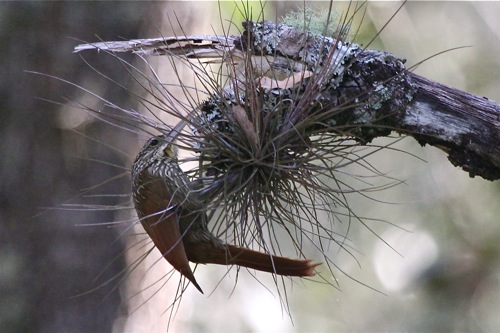
We headed back into the drier oak woods for a picnic, hoping that a curious band of Spotted Wrens would stop by. Both male and female Hooded Grosbeaks allowed scope views while we ate lunch. Also in this area were an Orange-billed Nightingale-Thrush, a Hepatic Tanager, and surprisingly, a Yellow-throated Warbler. A Long-billed Thrasher posed for photographs in the roadside brush.
 |
 |
| singing male Singing Quail |
singing male Rusty Sparrow |
 |
 |
| Ivory-billed Woodcreeper | Long-billed Thrasher |

Day 9: El Naranjo to Tlanchinol
We devoted the morning to cleaning up two sought-after species: Military Macaw and coeruliceps Blue-crowned Motmot. The macaw could really fly over anywhere, so we concentrated on some better locations for the motmot. At the first place we found a rather tame covey of about 12 Singing Quail right alongside the trail. There were also numerous Thicket Tinamous singing from the forest, one quite close by. We were about to look for the nearby tinamou when we heard macaws—lots of them by the sound of it. They sounded like they were beyond the trees and out of range of our vision, so we started walking the trail through a mosaic of forest and sugar cane fields. In about 400m we caught sight of them at the top of the next hill—all 30 of them! I’d sever seen a flock of Military Macaws this big in Mexico—very exciting! It was then off to my prime motmot location; we’d missed them there the day before, but you never know. Within moments, we heard a Blue-crowned Motmot singing, but it sounded quite distant. While walking towards the sound, though, it became apparent that the bird was actually quite close by but singing softly. It was practically overhead, in fact! We enjoyed prolonged scope views of this bird and its mate over the next half hour, marveling at their serrated bill edges, odd racket-tipped tails, and opalescent blue crowns. (This northeast Mexican endemic subspecies is oddly enough the only Blue-crowned Motmot which actually has a blue crown!) With both targets down, we jubilantly headed south towards Tlanchinol. A short evening trip into the cloudforest was very quiet, with Common Bush-Tanager and Band-tailed Pigeon being the highlights.
 |
 |
| Military Macaws |
Military Macaws |
 Day 10:
Tlanchinol and Huejutla
Day 10:
Tlanchinol and HuejutlaWe endured an early morning start today with the hope that we might catch some ground-feeding birds like antpittas, quail-doves, and thrushes out on the main trail at first light. A gorgeous Black-headed Nightingale-Thrush hopped into the spotlight and went about his business just below the parking area. A female Black Robin paused on the trail for a moment. A bit further down the trail, we found a small canopy flock dominated by bush-tanagers, but we were also able to pick out Cassin’s Vireo, Crescent-chested Warbler, Spot-crowned Woodcreeper, and Brown-capped Vireo. Intermittent flashes of white in the dark understory transformed into the glowing throat of a smart-looking Chestnut-capped Brush-finch. A Bearded Wood-Partridge sang from far downslope. By now, dense fog was sending its fingers deep into the forest, and visibility was reduced enough that birding was getting impractical—always a possibility when visiting a cloud forest. We did somehow manage to peer through the mist to see a male Mountain Trogon and a male Rose-throated Becard next to the car. A tree full of Hooded Grosbeaks and Black-headed Siskins, though, was too far to see well. We made the decision to descend, hoping that we’d come out below the clouds. That we did, and although there was a steady mist falling from the low clouds, we had the best birding of the tour in the next couple hours. We found ourselves in the midst of a massive passerine flock that contained literally hundreds of birds, and managed to stay with the flock our entire time there. Nashville Warblers easily numbered into three figures, and Wilson’s Warblers weren’t far behind. Other species we found in the flock included Yellow-winged and White-winged Tanagers, Montezuma Oropendola, Audubon’s Oriole, Black-headed Saltator, Bronze-winged Woodpecker, Brown-backed Solitaire, Yellow-throated Euphonia, Lincoln’s Sparrow, and Crescent-chested, Black-throated Green, Black-and-white, Townsend’s, Golden-crowned, and Rufous-capped Warblers. A female Amethyst-throated Hummingbird obligingly showed us her long white eyeline and gray tail spots. Even though there literally birds dripping off the trees, the wet conditions were getting to us, so we descended further to Huejutla for a hot lunch. After lunch, we hit a lowland spot just outside of town on the Hidalgo-Veracruz border. A Ferruginous Pygmy-Owl brought in a nice group of scolding birds, including Scrub Euphonia, Spot-breasted Wren, White-eyed Vireo, Northern Beardless-Tyrannulet, and a glittering male Canivet’s Emerald.
 |
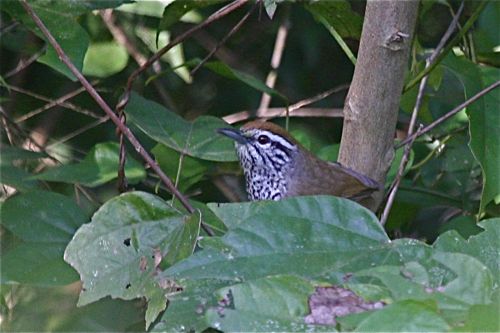 |
| Brown-capped Vireo | Spot-breasted Wren |
 |
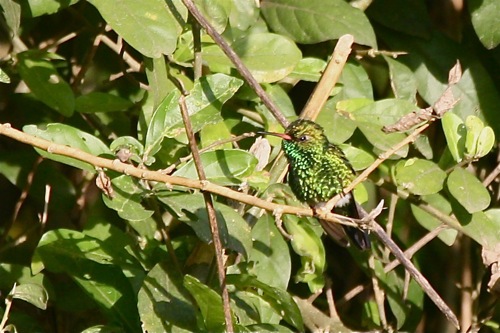 |
| male Bronze-winged Wodpecker | male Canivet's Emerald |
Day 11: Tlanchinol to El Tajín and Tecolutla
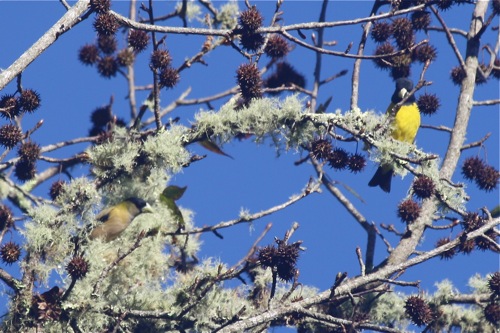
We still had visions of antpittas dancing in our heads, so we opted for another early rise. No antpittas as it turned out, but instead we had a nice comparison between Clay-colored and Black Robins on the trail. In sharp contrast to the day before, it was a completely clear day, making for much better visibility. A noisy and curious flock of 6 Azure-hooded Jays appeared overhead, and they followed us for the next hour or more. A large rufous bird swooped past and flew up to a large bromeliad: a Strong-billed Woodcreeper and a real treat since the species is very hard to find here at the northern edge of its range. Dozens of Hooded Grosbeaks and Black-headed Siskins fed in the top of a sweet gum, providing excellent studies. Common Bush-Tanagers were ubiquitous. Finally, a pair of Chestnut-capped Brush-finches performed nicely next to the car before we left the Tlanchinol area.
 |
 |
| Hooded Grosbeaks (female on left) |
Azure-hooded Jay |
 |
 |
| Strong-billed Woodcreeper | Common Bush-Tanager |
Next stop: El Tajín, one of the most underrated tourist attractions in Mexico, in my opinion . . . if we could get there! Tomorrow was “El Día de Nuestra Señora de Guadalupe”, and there were bicycle and jogging relays all up and down the highways. We did finally arrive, but an hour later than planned. El Tajín (meaning “city of thunder”) was built about 2,000 years ago by the Totonacs, who also first discovered the joys of vanilla. Their descendants still live in the area and sell amazingly cheap and deliciously complex vanilla pods for bargain prices. Wandering about the exquisite pyramids (particularly the Pyramid of the Niches) and immense ball courts, we saw Vaux’s Swifts, Plain Chachalacas, a Pale-billed Woodpecker, and what I can only assume is the same tame Roadside Hawk I’ve seen at this location the past 6 years. Montezuma Oropendolas provided their bizarre song as a worthy backdrop for this amazing location.
We had just enough time in the evening to hit the marsh outside Tecolutla. Sadly, the town is quickly encroaching into the marsh, and much of what was pristine habitat just two years prior is now a slum. On this depressing visit, we saw Muscovy Duck, Green Heron, Northern Jaçana, Swamp Sparrow, Gray-crowned Yellowthroat, and a seemingly lost Hermit Thrush.
 |
 |
| El Tajín (Pyramid of the Niches on the left) | one of El Tajín's more "minor" pyramids |
 |
 |
| adult Roadside Hawk | Montezuma Oropendola |
Day 12: Tecolutla to Xalapa
It was easily decided that we needed to find an alternate birding location for the morning, so we opted for an estuary on the western edge of the beach. A Gray-necked Wood-Rail feeding in the open along the edge of the mangroves was hands-down the star of the show. We found a Common Black-Hawk and a pair of Aplomado Falcons perched in some emergent trees. A Laughing Falcon and a Ruddy Crake taunted us by calling from just out of sight.
After breakfast (accompanied by a parade for our new friend, the Virgin of Guadalupe) and checkout from the hotel, we tarried a bit in the parking lot to view a Yellow-throated Warbler in the coconut palms. Highlights of a trip to the sandbars at the mouth of the Río Tecolutla included Royal Tern and Collared Plover. On our way out of town, we said goodbye to the last flocks of Tamaulipas Crows since we’d be driving south out of their range in just a few minutes.
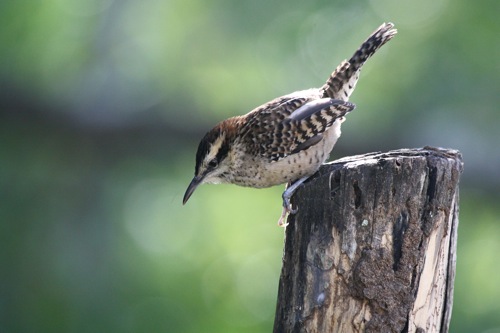
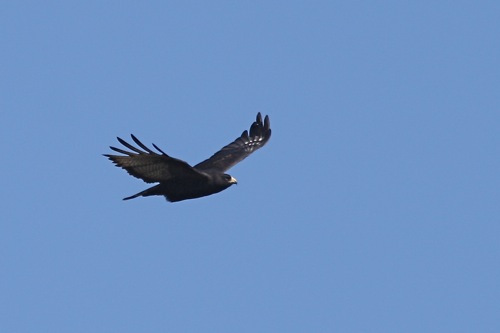
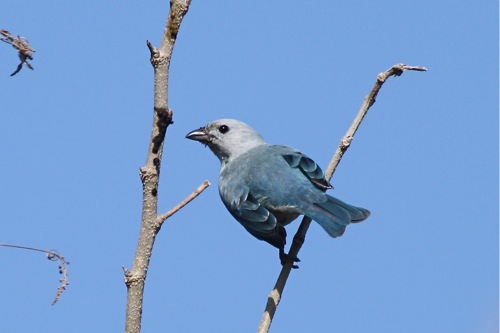
Next we stopped at spot along the coast to look for Mexican Sheartail and the nominate subspecies of Rufous-naped Wren. The latter, which bears little resemblance to the other subspecies, is endemic to a tiny strip of coastal thornscrub in central Veracruz and the only one found on the Atlantic slope. The wren was very easy to find, but there were almost no flowers, so the sheartail was understandably much harder. We had a picnic lunch at the only patch of flowering red Turk’s cap (Malvaviscus) we located, hoping for an appearance by the sheartail. Buff-bellied was the only hummingbird we found, but we did enjoy amazingly close views of White-collared Swift, as a hundred or so fed just overhead. Ruddy Crakes called from the nearby marsh, and checking the Turkey Vultures yielded both Zone-tailed Hawks and Lesser Yellow-headed Vultures, also just overhead. Some brief whistling in a patch of scrub along the coastal dunes brought in an angry mob including Blue-gray Tanager, Yellow-breasted Chat, Blue-black Grassquit, more “Veracruz” Rufous-naped Wrens, Acadian, Least, and Brown-crested Flycatchers, and Indigo and Painted Buntings.
Since we’d not had much luck with the sheartail, another stop on the way to Xalapa was warranted. It didn’t produce the target bird, but Scissor-tailed Flycatcher was a welcome addition to the trip list. Lesser Nighthawks fed alongside the road as we drove on.
 |
 |
|
| Yellow-throated Warbler | "Veracruz" Rufous-naped Wren | |
 |
 |
|
| Zone-tailed Hawk | White-collared Swift |
|
 |
 |
|
| central Veracruz coastline | Blue-gray Tanager |
Day 13: Las Minas to Córdoba
A small norte blew through during the night, but our birding location was so high in elevation that we were above the clouds. However, it was cold, as evidenced by the 3-inch long ice crystals jutting out of the ground! The north-south orientation of the Las Minas canyon created a natural wind tunnel, and birding the canyon was simply impossible, but not to worry--there’s other great birding nearby. First a flock of rather shy Steller’s Jays melted deep into the woods. Shortly thereafter, we came across a mixed flock of temperate birds in the young pine woods: “Black-eared” Bushtits, Mexican Chickadees, Olive Warblers, White-breasted Nuthatches, Brown Creepers, and Hermit and Townsend’s Warblers. A “Brown-throated” Wren sang from an exposed perch in the scrubby understory. Then a nice surprise: a pair of Hooded Yellowthroats, not previously reported from this site to my knowledge, appeared in some brush near the wren. A thin, hollow tinkling heard just down the road turned into a very cooperative Russet Nightingale-Thrush. Amazingly, he posed for us on an exposed branch where we marveled at out ability to see usually ridiculously hard-to-see field marks, like the dark tip to the (lower) mandible. All the while, streams of American Robins were passing overhead.
With a few hours now passed, we returned to the canyon to check on the weather conditions. To our great relief, the wind had completely stopped and bird and butterfly activity was high. A patch of fruiting mistletoes attracted a small flock of Gray Silkies and a male Elegant Euphonia. We saw lots of warblers over the next few hours, with Slate-throated Whitestart and Crescent-chested, Townsend’s, Hermit, and “Audubon’s” Warblers dominating the flocks. Time and patience in some denser, wetter understory yielded views of some cloud forest species: Gray-breasted Wood-Wren, Rufous-capped Brush-finch, and the exquisite Golden-browed Warbler. Fruiting alders held a flock of Black-headed Siskins. Nearer the highway we stopped in some bunch grass (Spartina), where we found a small flock of the charming (and large) Striped Sparrow.
On the way down to the coast, we stopped at a pine forest location to look for Red Warbler. We found great diversity of warblers, but no Reds. Another stop for sheartail was unsuccessful, but we did get point blank views of a gorgeous Aplomado Falcon.
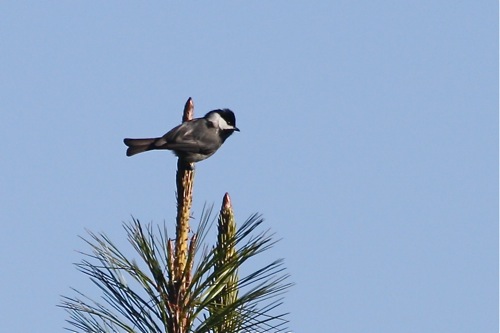 |
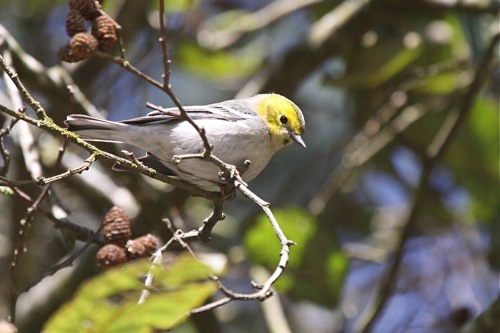 |
|
| Mexican Chickadee | Hermit Warbler | |
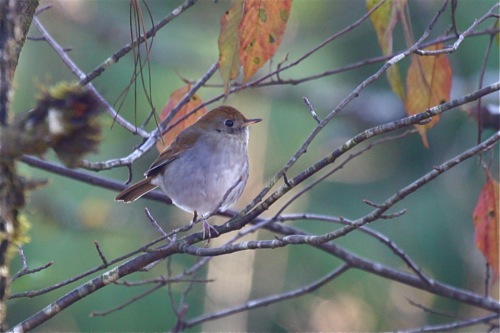 |
 |
|
| Russet Nightingale-Thrush | "Brown-throated" Wren |
|
 |
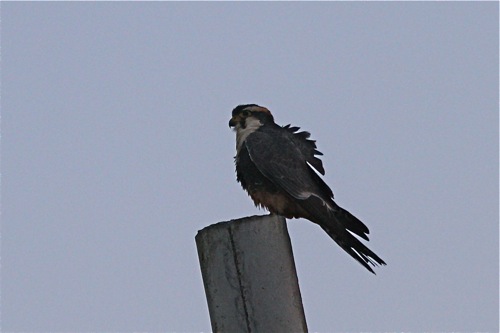 |
|
| Striped Sparrow | Aplomado Falcon |
Day 14: Amatlán and Las Barrancas
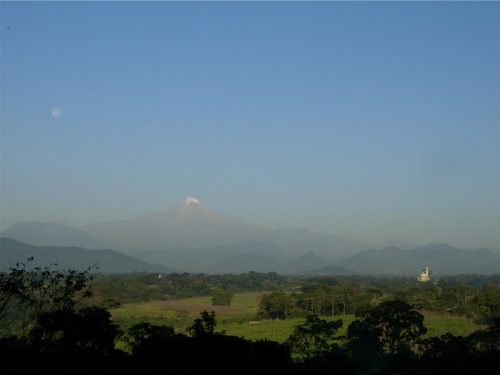
We awoke in the shadow of the massive 18,490-foot Pico de Orizaba. Ranked the world’s seventh most prominent peak, this glacier-capped volcano is literally an awesome sight and served as a reminder that we were now on the edge of the central volcanic belt. This morning was the culmination of 13 days to slow southerly progression. We’d started out on high desert plateau, where the only “non-U.S.” bird was Worthen’s Sparrow but now found ourselves in lowland Gulf-slope rainforest, as attested to by the Collared Araçari that flushed up as we stepped out of the car. A Laughing Falcon called from a long palm in the distance and allowed brief views thought the scope before departing. We were visiting a famous coffee plantation near the village of Amatlán—famous because it’s one of the most accessible sites to see the crazy-looking endemic Sumichrast’s Wren, which hops in and out of the cracks in the shaded karst (limestone outcroppings). Two new hummingbirds appeared right away: White-bellied Emerald and Stripe-throated Hermit. In the dark understory we found a family of Red-throated Ant-Tanagers, a Kentucky Warbler, some Hooded Warblers, a Wood Thrush, and more Fan-tailed Warblers. We hiked quite a way through the plantation without so much as hearing a Sumichrast’s Wren, but we did see a couple White-breasted Wood-Wrens, a Spot-breasted Wren, and a troop of Band-backed Wrens. A pair of Lesser Greenlets put in a brief appearance. A vociferous Ferruginous Pygmy-Owl attracted a Magnolia Warbler, an American Redstart, and a Rufous-tailed Hummingbird. We had turned around and were literally mere meters from the car, when a rusty brown bird dashed through the understory and started sputtering. The bird turned its head to reveal an incredibly long, slender bill and a black ear patch—we’d found a Sumichrast’s Wren! The wren happily fed in the leaf litter and amongst the karst a few meters away, pausing to sing every once in awhile. After a half hour of this remarkable show, we decided it was time to move on.
 |
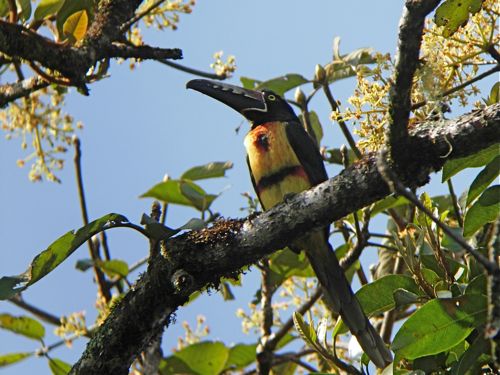 |
| Pico de Orizaba and Amatlán | Collared Araçari |
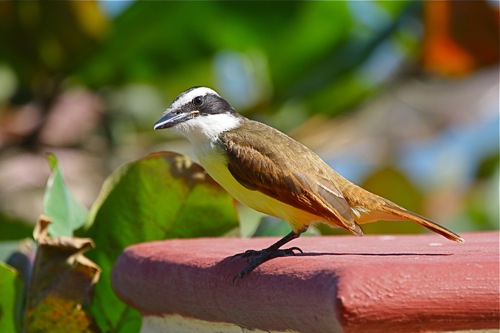
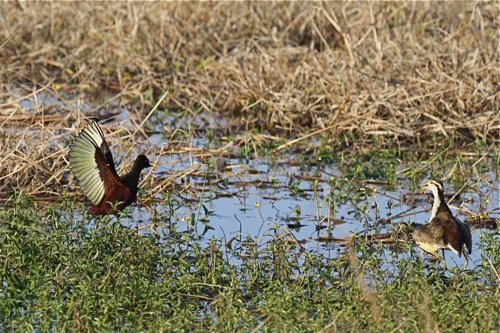
After a midday hotel check-in, we enjoyed a seaside lunch, complete with Magnificent Frigatebirds, Osprey, Reddish Egret, and a very hungry Great Kiskadee. We took the birds’ advice and enjoyed an early afternoon siesta in the heat of the day before proceeding to our last birding spot, Las Barrancas. On the drive in we were welcomed by a Tropical Mockingbird and a family of Groove-billed Anis. While noting the mockingbird’s field marks, we noticed a covey of Northern Bobwhite running across the pasture. We were far enough south now to be in range for one of the Mexican endemic subspecies; this one, pectoralis, has a broad black chest band that extends into black streaks on a rusty belly and is endemic to the Gulf slope from here to Tabasco. Las Barrancas (contrary to the name) is a savannah/marsh site, but thanks to the dry season we encountered no insects other than thousands of butterflies. Unfortunately, this was a particularly dry season, and many of the marshes had dried up. Still, we were able to locate a Purple Gallinule, a Snail Kite, and a number of Northern Jaçanas. Lesser Yellow-headed Vultures were abundant, and a number of perched birds allowed us to marvel at their amazing aquamarine, red, yellow, pink, and lavender facial skin—definitely an underrated bird. We were enjoying a small group of Fork-tailed Flycatchers when a hungry Merlin made a pass at them, which produced some impressive aerial acrobatics on the part of the flycatchers! The roadside brush held a bevy of colorful birds: Northern Cardinal, Orchard Oriole, Painted Bunting, Altamira Oriole, and Vermilion Flycatcher to name a few. Savannah Sparrows were everywhere. Soon, the sun was setting, and it was time to look for one final bird. Slowly driving back towards the highway, we head some strange noises, and found our targets perched atop an old railroad grade. We drove closer, slowly toward the birds and enjoyed remarkable views of about 20 Double-striped Thick-knees. An Aplomado Falcon lit on a fencepost right next to us as well—a very satisfactory ending to an exciting tour.
 |
 |
|
| Reddish Egret | tableside Great Kiskadee |
|
 |
 |
|
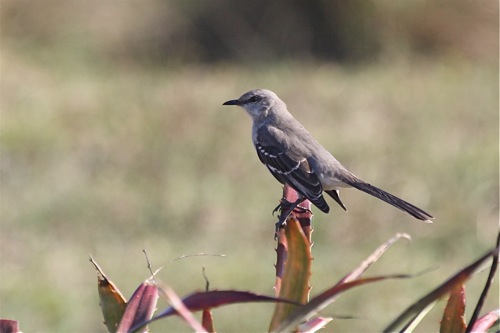
| a family of Northern Jaçanas | Tropical Mockingbird | |
 |
 |
|
| Fork-tailed Flycatcher | Fork-tailed Flycatcher dodging a Merlin | |
 |
 |
|
| Lesser Yellow-headed Vulture | Double-striped Thick-knees |
This list includes all the bird species that were recorded by at least one of us. Taxonomy and nomenclature closely follow Howell's Checklist of the Birds of Mexico and all subsequent AOU supplements. Quotation marks denote a possible future split. For instance, "Eastern" Blue Bunting means that the eastern form may one day be split from Blue Bunting. Brackets denote the larger taxon that a species has been split from. For instance, Galápagos [Audubon's] Shearwater means that Galápagos Shearwater was once considered a subspecies of Audubon's Shearwater (and may still be by some authorities). Parentheses denote an alternate name used by some checklists.
Totals:
326 bird species recorded
13 heard only
h = heard only
L = leader only
^ = endemic to northern Middle America
* = endemic to Mexico
(E) = endemic to the non-peninsular Gulf slope of northern Middle America
(SW) = endemic to interior southwestern Mexico
(W) = endemic to the Pacific (western) slope of northern Middle America
(SMS) = endemic to the Sierra Madre del Sur of Mexico
h x x x x x x x x x x x x x x x x x x x L x x x x x x x x x x x x x x x x x x x x x x x x x x x x x x x x x x x x x x x x x x h x x x x x x x h x h x x x x L x x x x x x x x x x x x x x x x x x x x x x x x x x x x x x x x x x x x x x x x h x h x d x x x x x x x x x x x h x x x x x x x x x x x x x x x x h x x x x x x h x x x x x x x x x x x x x x x x x x x x x x x x x x x x x x x x L x x x x x x x x x x x x x x x x x x x x x x x x x x x x x x x x x x x x x h x x x x h x x x x x x x x x x x x x x x x x x x x h x x x x x x x x x x x x x x x x x x x x x x x x x x x x x x x x x x x x x L x x x x x x x x x x x x x x x x x x x x x x x x x x x x x x x x x x x x x x x x h x x x x x x x x x x x |
TINAMOUS:
Tinamidae Thicket Tinamou WATERFOWL: Anatidae Black-bellied Whistling-Duck Snow Goose Ross's Goose Muscovy Duck Gadwall "Mexican Duck" Mottled Duck Blue-winged Teal Cinnamon Teal Northern Shoveler Northern Pintail Green-winged Teal Canvasback Ring-necked Duck Lesser Scaup Ruddy Duck CRACIDS: Cracidae Plain Chachalaca Crested Guan PHEASANTS and TURKEYS: Phasianidae Wild Turkey NEW WORLD QUAIL: Odontophoridae Bearded Wood-Partridge Scaled Quail Northern Bobwhite Singing Quail^ GREBES: Podicipedidae Pied-billed Grebe PELICANS: Pelecanidae American White Pelican Brown Pelican CORMORANTS: Phalacrocoracidae Neotropic Cormorant Double-crested Cormorant DARTERS: Anhingidae Anhinga FRIGATEBIRDS: Fregatidae Magnificent Frigatebird HERONS: Ardeidae Great Blue Heron Great Egret Snowy Egret Little Blue Heron Tricolored Heron Reddish Egret Cattle Egret Green Heron Yellow-crowned Night-Heron Boat-billed Heron IBISES and SPOONBILLS: Threskiornithidae White Ibis White-faced Ibis Roseate Spoonbill STORKS: Ciconiidae Wood Stork NEW WORLD VULTURES: Cathartidae Black Vulture Turkey Vulture Lesser Yellow-headed Vulture TYPICAL RAPTORS: Acciptridae Osprey White-tailed Kite Snail Kite Northern Harrier Sharp-shinned Hawk Cooper's Hawk Common Black-Hawk Roadside Hawk Gray Hawk Swainson's Hawk White-tailed Hawk Zone-tailed Hawk Red-tailed Hawk Ferruginous Hawk Ornate Hawk-Eagle FALCONS and CARACARAS: Falconidae Collared Forest-Falcon Crested Caracara Laughing Falcon American Kestrel Merlin Aplomado Falcon Bat Falcon Prairie Falcon RAILS, GALLINULES, and COOTS: Rallidae Ruddy Crake^ Gray-necked Wood-Rail Sora Purple Gallinule Common Moorhen American Coot FINFOOTS: Heliornithidae Sungrebe LIMPKIN: Aramidae Limpkin THICK-KNEES: Burhinidae Double-striped Thick-knee PLOVERS: Charadriidae Black-bellied Plover Collared Plover Killdeer OYSTERCATCHERS: Haematopodidae American Oystercatcher STILTS and AVOCETS: Recurvirostridae Black-necked Stilt American Avocet JAÇANAS: Jacanidae Northern Jaçana SANDPIPERS: Scolopacidae Spotted Sandpiper Greater Yellowlegs "Western" Willet Lesser Yellowlegs Long-billed Curlew Sanderling Semipalmated Sandpiper Least Sandpiper GULLS: Larinae Laughing Gull Ring-billed Gull "American" Herring Gull Thayer's Gull TERNS: Sterninae Caspian Tern Forster's Tern Royal Tern PIGEONS and DOVES: Columbidae Rock Pigeon Red-billed Pigeon Band-tailed Pigeon Eurasian Collared-Dove White-winged Dove Mourning Dove Inca Dove Common Ground-Dove White-tipped Dove PARROTS: Psittacidae Green Parakeet^ Military Macaw White-crowned Parrot Red-lored Parrot Yellow-headed Parrot^ CUCKOOS: Cuculidae "Common" Squirrel Cuckoo Greater Roadrunner Groove-billed Ani OWLS: Strigiformes Eastern Screech-Owl Ferruginous Pygmy-Owl Mottled Owl NIGHTJARS and NIGHTHAWKS: Caprimulgidae Lesser Nighthawk Common Poorwill SWIFTS: Apodidae White-collared Swift Vaux's Swift White-throated Swift HUMMINGBIRDS: Trochilidae Stripe-throated [Little] Hermit Wedge-tailed Sabrewing^ Canivet's Emerald^ White-bellied Emerald^ Rufous-tailed Hummingbird Buff-bellied Hummingbird Amethyst-throated Hummingbird^ TROGONS and QUETZALS: Trogonidae Mountain Trogon^ "Coppery-tailed" Elegant Trogon MOTMOTS: Momotidae "Tamaulipas" Blue-crowned Motmot* (NE) KINGFISHERS: Alcedinidae Ringed Kingfisher Belted Kingfisher Amazon Kingfisher Green Kingfisher TOUCANS and NEW WORLD BARBETS: Ramphastidae Collared Araçari WOODPECKERS: Picidae Acorn Woodpecker Golden-fronted Woodpecker Yellow-bellied Sapsucker Ladder-backed Woodpecker Hairy Woodpecker Smoky-brown Woodpecker Bronze-winged [Golden-olive] Woodpecker "Red-shafted" Northern Flicker Lineated Woodpecker Pale-billed Woodpecker FURNARIIDS (incl. WOODCREEPERS): Furnariidae Rufous-breasted Spinetail^ Olivaceous Woodcreeper Strong-billed Woodcreeper Ivory-billed Woodcreeper Spot-crowned Woodcreeper TYPICAL ANTBIRDS: Thamnophilidae Barred Antshrike TYRANT FLYCATCHERS: Tyrannidae Northern Beardless-Tyrannulet Tufted Flycatcher Greater Pewee Acadian Flycatcher Least Flycatcher Hammond's Flycatcher Gray Flycatcher Pine Flycatcher^ "Western" Flycatcher Black Phoebe Eastern Phoebe Say's Phoebe Vermilion Flycatcher Dusky-capped Flycatcher Brown-crested Flycatcher Great Kiskadee Boat-billed Flycatcher Social Flycatcher Tropical Kingbird Couch's Kingbird Cassin's Kingbird Western Kingbird Scissor-tailed Flycatcher Fork-tailed Flycatcher genera INCERTAE SEDIS Gray-collared Becard^ Rose-throated Becard Masked Tityra SHRIKES: Laniidae Loggerhead Shrike VIREOS: Vireonidae White-eyed Vireo Cassin's Vireo Blue-headed Vireo Hutton's Vireo "Eastern" Warbling Vireo Brown-capped Vireo Lesser Greenlet CORVIDS: Corvidae Steller's Jay Green Jay Brown Jay Azure-hooded Jay Mexican Jay Tamaulipas Crow* (NE) Chihuahuan Raven Common Raven LARKS: Alaudidae Horned Lark SWALLOWS: Hirundinidae Tree Swallow Mangrove Swallow Northern Rough-winged Swallow Cave Swallow TITS: Paridae Mexican Chickadee Bridled Titmouse Black-crested Titmouse LONG-TAILED TITS: Aegithalidae Bushtit NUTHATCHES: Sittidae White-breasted Nuthatch CREEPERS: Certhiidae Brown Creeper WRENS: Troglodytidae Band-backed Wren Rufous-naped Wren (W) Cactus Wren Canyon Wren Sumichrast's Wren* (E) Spot-breasted Wren Carolina Wren Bewick's Wren "Northern" House Wren "Brown-throated" Wren White-breasted Wood-Wren Gray-breasted Wood-Wren KINGLETS: Regulidae Ruby-crowned Kinglet GNATCATCHERS & GNATWRENS: Polioptilinae Blue-gray Gnatcatcher THRUSHES: Turdidae Eastern Bluebird Western Bluebird Mountain Bluebird Brown-backed Solitaire^ Slate-colored Solitaire^ Orange-billed Nightingale-Thrush Russet Nightingale-Thrush* Black-headed Nightingale-Thrush Hermit Thrush Wood Thrush Black Robin* Clay-colored Robin White-throated Robin American Robin MIMIDS: Mimidae Gray Catbird Northern Mockingbird Tropical Mockingbird Long-billed Thrasher Curve-billed Thrasher Blue Mockingbird* PIPITS and WAGTAILS: Motacillidae American Pipit Sprague's Pipit SILKY-FLYCATCHERS: Ptilogonatidae Gray Silky(-flycatcher)^ OLIVE WARBLER: Peucidramidae Olive Warbler NEW WORLD WARBLERS: Parulidae Orange-crowned Warbler Nashville Warbler Crescent-chested Warbler^ Northern Parula Tropical Parula Yellow Warbler Magnolia Warbler "Myrtle" Yellow-rumped Warbler "Audubon's" Yellow-rumped Warbler Black-throated Green Warbler Townsend's Warbler Hermit Warbler Yellow-throated Warbler Grace's Warbler Black-and-white Warbler American Redstart Ovenbird Northern Waterthrush Louisiana Waterthrush Kentucky Warbler Common Yellowthroat Altamira Yellowthroat* (NE) Hooded Yellowthroat* Gray-crowned Yellowthroat Hooded Warbler Wilson's Warbler Painted Whitestart Slate-throated Whitestart Fan-tailed Warbler^ Golden-crowned Warbler Rufous-capped Warbler* Golden-browed Warbler^ Yellow-breasted Chat TANAGERS: Thraupidae "Hidalgo" Common Bush-Tanager* (E) Red-throated Ant-Tanager Hepatic Tanager Summer Tanager Western Tanager Flame-colored Tanager White-winged Tanager Blue-gray Tanager Yellow-winged Tanager^ EMBERIZIDS: Emberizidae Blue-black Grassquit White-collared Seedeater Yellow-faced Grassquit Rufous-capped Brush-finch* Chestnut-capped Brush-finch Olive Sparrow Spotted Towhee Canyon Towhee Cassin's Sparrow Rusty Sparrow Striped Sparrow Chipping Sparrow Worthen's Sparrow* Vesper Sparrow Lark Sparrow Black-throated Sparrow Lark Bunting Savannah Sparrow Lincoln's Sparrow Swamp Sparrow Yellow-eyed Junco CARDINALIDS: Cardinalidae "Eastern" Grayish Saltator Black-headed Saltator Crimson-collared Grosbeak* (NE) Northern Cardinal Rose-breasted Grosbeak "Eastern" Blue Bunting^ Blue Grosbeak Lazuli Bunting Indigo Bunting Painted Bunting ICTERIDS: Icteridae Red-winged Blackbird Eastern Meadowlark Western Meadowlark Melodious Blackbird Brewer's Blackbird Great-tailed Grackle Bronzed Cowbird Brown-headed Cowbird Orchard Oriole Hooded Oriole Altamira Oriole Audubon's Oriole Yellow-billed Cacique Montezuma Oropendola FINCHES: Fringillidae Scrub Euphonia Yellow-throated Euphonia Elegant [Blue-hooded] Euphonia^ House Finch Pine Siskin Black-headed Siskin^ Lesser Goldfinch American Goldfinch Hooded Grosbeak^ OLD WORLD SPARROWS: Passeridae House Sparrow |
Crypturellus cinnamomeus Dendrocygna autumnalis Chen caerulescens Chen rossii Cairina moschata Anas strepera Anas platyrhynchos diazi Anas fulvigula Anas discors Anas cyanoptera Anas clypeata Anas acuta Anas crecca Aythya valisineria Aythya collaris Aythya affinis Oxyura jamaicensis Ortalis vetula Penelope purpurascens Meleagris gallopavo Dendrortyx barbatus Callipepla squamata Colinus virginianus Dactylortyx thoracicus Podilymbus podiceps Pelecanus erythrorhynchos Pelecanus occidentalis Phalacrocorax brasilianus Phalacrocorax auritus Anhinga anhinga Fregata magnificens Ardea herodias Ardea alba Egretta thula Egretta caerulea Egretta tricolor Egretta rufescens Bubulcus ibis Butorides virescens Nyctanassa violacea Cochlearius cochlearius Eudocimus albus Plegadis chihi Platalea ajaja Mycteria americana Coragyps atratus Cathartes aura Cathartes burrovianus Pandion haliaetus Elanus leucurus Rostrhamus sociabilis Circus cyaneus Accipiter s. striatus group Accipiter cooperii Buteogallus anthracinus Buteo magnirostris Buteo nitidus Buteo swainsoni Buteo albicaudatus Buteo albonotatus Buteo jamaicensis Buteo regalis Spizaetus ornatus Micrastur semitorquatus Caracara cheriway Herpetotheres cachinnans Falco sparverius Falco columbarius Falco femoralis Falco rufigularis Falco mexicanus Laterallus ruber Aramides cajanea Porzana carolina Porphyrio martinica Gallinula chloropus Fulica americana Heliornis fulica Aramus guarauna Burhinus bistriatus Pluvialis squatarola Charadrius collaris Charadrius vociferus Haematopus palliatus Himantopus mexicanus Recurvirostra americana Jacana spinosa Actitis macularius Tringa melanoleuca Tringa s. inornata Tringa flavipes Numenius americanus Calidris alba Calidris pusilla Calidris minutilla Leucophaeus atricilla Larus delawarensis Larus argentatus smithsonianus Larus thayeri Hydroprogne caspia Sterna forsteri Thalasseus maximus Columba livia Patagioenas flavirostris Patagioenas fasciata Streptopelia decaocto Zenaida asiatica Zenaida macroura Columbina inca Columbina passerina Leptotila verreauxi Aratinga holochlora Ara militaris Pionus senilis Amazona autumnalis Amazona oratrix Piaya cayana cayana group Geococcyx californianus Crotophaga sulcirostris Megascops asio Glaucidium brasilianum Ciccaba virgata Chordeiles acutipennis Phalaenoptilus nuttallii Streptoprocne zonaris Chaetura vauxi Aeronautes saxatalis Phaethornis striigularis Campylopterus curvipennis Chlorostilbon canivetii Amazilia candida Amazilia tzacatl Amazilia yucatanensis Lampornis amethystinus Trogon mexicanus Trogon elegans Momotus momota coeruliceps Megaceryle torquatus Megaceryle alcyon Chloroceryle amazona Chloroceryle americana Pteroglossus torquatus Melanerpes formicivorus Melanerpes aurifrons Sphyrapicus varius Picoides scalaris Picoides villosus Veniliornis fumigatus Colaptes [r.] aeruginosus Colaptes auratus cafer group Dryocopus lineatus Campephilus guatemalensis Synallaxis erythrothorax Sittasomus griseicapillus Xiphocolaptes promeropirhynchus Xiphorhynchus flavigaster Lepidocolaptes affinis Thamnophilus doliatus Camptostoma imberbe Mitrephanes phaeocercus Contopus pertinax Empidonax virescens Empidonax minimus Empidonax hammondii Empidonax wrightii Empidonax affinis Empidonax difficilis/occidentalis Sayornis nigricans Sayornis phoebe Sayornis saya Pyrocephalus rubinus Myiarchus tuberculifer Myiarchus tyrannulus Pitangus sulphuratus Megarynchus pitangua Myiozetetes similis Tyrannus melancholicus Tyrannus couchii Tyrannus vociferans Tyrannus verticalis Tyrannus forficatus Tyrannus savana Pachyramphus major Pachyramphus aglaiae Tityra semifasciata Lanius ludovicianus Vireo griseus Vireo cassinii Vireo solitarius Vireo huttoni Vireo gilvus gilvus group Vireo leucophrys Hylophilus decurtatus Cyanocitta stelleri Cyanocorax [yncas] luxuosus Cyanocorax morio Cyanolyca cucullata Aphelocoma ultramarina Corvus imparatus Corvus cryptoleucus Corvus corax Eremophila alpestris Tachycineta bicolor Tachycineta albilinea Stelgidopteryx serripennis Petrochelidon fulva Poecile sclateri Baeolophus wollweberi Baeolophus atricristatus Psaltriparus minimus Sitta carolinensis Certhia americana Campylorhynchus zonatus Campylorhynchus rufinucha Campylorhynchus brunneicapillus Catherpes mexicanus Hylorchilus sumichrasti Thryothorus maculipectus Thryothorus ludovicianus Thryomanes bewickii Troglodytes a. aedon Troglodytes a. brunneicollis Henicorhina leucosticta Henicorhina leucophrys Regulus calendula Polioptila caerulea Sialia sialis Sialia mexicana Sialia currucoides Myadestes occidentalis Myadestes unicolor Catharus aurantiirostris Catharus occidentalis Catharus mexicanus Catharus guttatus Hylocichla mustelina Turdus infuscatus Turdus grayi Turdus assimilis Turdus migratorius Dumetella carolinensis Mimus polyglottos Mimus gilvus Toxostoma longirostre Toxostoma curvirostre Melanotis caerulescens Anthus rubescens Anthus spragueii Ptilogonys cinereus Peucedramus taeniatus Vermivora celata Vermivora ruficapilla Parula superciliosa Parula americana Parula pitiayumi Dendroica p. aestivia group Dendroica magnolia Dendroica c. coronata Dendroica c. auduboni group Dendroica virens Dendroica townsendi Dendroica occidentalis Dendroica dominica Dendroica graciae Mniotilta varia Setophaga ruticilla Seiurus aurocapilla Seiurus noveboracensis Seiurus motacilla Oporornis formosus Geothlypis trichas Geothlypis flavovelata Geothlypis nelsoni Geothlypis poliocephala Wilsonia citrina Wilsonia pusilla Myioborus pictus Myioborus miniatus Euthlypis lachrymosa Basileuterus culicivorus Basileuterus rufifrons Basileuterus belli Icteria virens Chlorospingus o. ophthalmicus Habia fuscicauda Piranga flava Piranga rubra Piranga ludoviciana Piranga bidentata Piranga leucoptera Thraupis episcopus Thraupis abbas Volatinia jacarina Sporophila [t.] morelleti Tiaris olivaceus Atlapetes pileatus Buarremon brunneinucha Arremonops rufivirgatus Pipilo maculatus Pipilo fuscus Aimophila cassinii Aimophila rufescens Oriturus superciliosus Spizella passerina Spizella wortheni Pooecetes gramineus Chondestes grammacus Amphispiza bilineata Calamospiza melanocorys Passerculus sandwichensis Melospiza lincolnii Melospiza georgiana Junco phaeonotus Saltator c. coerulescens Saltator a. atriceps Rhodothraupis celaeno Cardinalis cardinalis Pheucticus ludovicianus Cyanocompsa p. parellina Passerina caerulea Passerina amoena Passerina cyanea Passerina ciris Agelaius phoeniceus Sturnella magna Sturnella neglecta Dives dives Euphagus cyanocephalus Quiscalus mexicanus Molothrus aeneus Molothrus ater Icterus s. spurius Icterus cucullatus Icterus gularis Icterus graduacauda Amblycercus holosericeus Psarocolius montezuma Euphonia affinis Euphonia hirundinacea Euphonia elegantissima Carpodacus mexicanus Carduelis pinus Carduelis notata Carduelis psaltria Carduelis tristis Coccothraustes abeillei Passer domesticus |
